

Ergonomic Companies and Products Guide

As more professionals look for ways to reduce pain, improve posture, and extend their working careers, ergonomic computer workstations — especially reclined and zero-gravity designs — have become increasingly popular. While many products promise comfort and productivity, they differ significantly in price, customization, stability, and long-term usability.
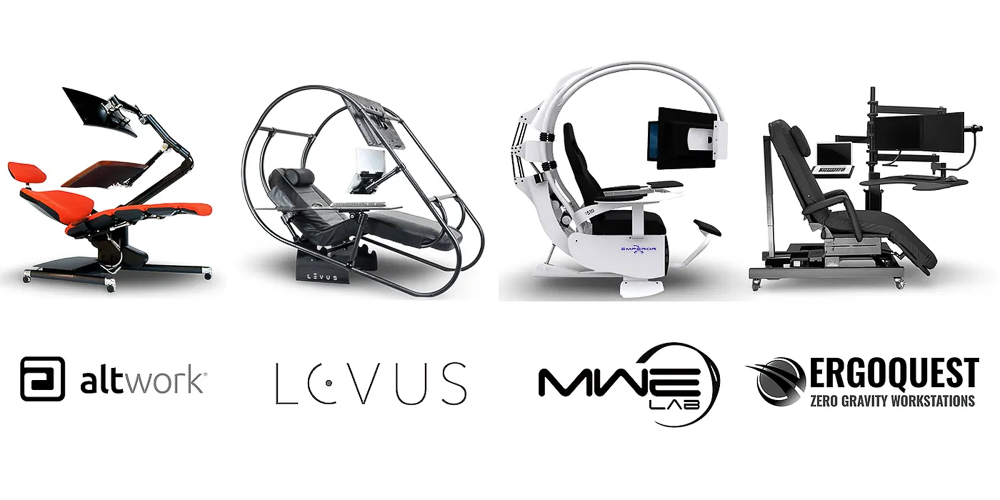
Below is a side-by-side look at four well-known ergonomic workstation manufacturers: Altwork, Levus, MWE Lab, and ErgoQuest.
Altwork
Founded: 2010
Headquarters: Geyserville, California, USA
Primary Product: Ergonomic computer workstation
Altwork is best known for its futuristic design and compact footprint. Its workstations often appeal to users who want a visually striking, all-in-one solution that fits into smaller spaces.
Pros
- Smaller footprint compared to many zero-gravity workstations
- Easily portable relative to competitors
- Clean, modern, and visually appealing design
Cons
- High price point (around $9,000)
- Limited customization options beyond monitor layouts and frame/fabric colors
- Some users report instability or wobbling during use
- Cushioning is often described as insufficient or uncomfortable for long sessions
Key Product
- Altwork Signature Station
Altwork can be a good fit for users prioritizing aesthetics and portability, but it may fall short for those seeking deep ergonomic customization or long-term comfort.
Levus
Founded: 2020
Headquarters: Vienna, Austria
Primary Product: Ergonomic computer workstation
Levus entered the market more recently with a strong focus on adjustability and value pricing. It aims to offer a highly configurable setup at a lower cost than many premium alternatives.
Pros
- More affordable price point (approximately $4,000)
- Many adjustable components
- Supports a wide range of monitor sizes and configurations
Cons
- Most adjustments require tools
- Recline changes require lifting the heavy frame and repositioning the stand
- Keyboard and mouse may slide or fall at steeper recline angles
- Long and complex assembly process
- No integrated cable management system
- Entering and exiting the workstation can be difficult
Key Product
- Levus Ergonomic Workstation
Levus may appeal to budget-conscious users who want flexibility, but its adjustment process and usability challenges can impact daily workflow.
MWE Lab
Founded: 2008
Headquarters: Quebec City, Quebec, Canada
Primary Product: Ergonomic computer workstations
MWE Lab focuses on semi-custom workstations that balance personalization and affordability. Their products are particularly known for distinctive designs and partial pre-assembly.
Pros
- Reasonable pricing (around $4,500)
- Wide range of customization options, including monitor setups, seat types, cable choices, and accessories
- Option to add a personal signature for a custom aesthetic
- Ships approximately 85% pre-assembled
Cons
- Shorter warranty (3 years, compared to 5 years offered by some competitors)
- No ability to adjust the distance between the monitor and your face
- User feedback suggests the keyboard tray could be improved
Key Products
- Emperor S2
- Emperor XT
- Emperor Pathojet
MWE Lab workstations are often chosen for their design-forward approach and mid-range pricing, though some ergonomic limitations remain.
ErgoQuest
Founded: 1997
Headquarters: Grand Rapids, Michigan, USA
Products: Ergonomic computer workstations and chairs
ErgoQuest has one of the longest track records in the ergonomic workstation industry and offers one of the widest product ranges available.
Pros
- All chairs are custom-sized to individual body dimensions
- Offers approximately 40 different ergonomic workstation models
- Extensive customization options and accessories
- Easy adjustment of monitor distance from the user’s face
- Wide price range, from entry-level solutions to premium setups ($895–$15,000)
Cons
- Fabrication times can sometimes be longer than expected due to customization
- Many workstations are larger and may not fit well in smaller spaces
- Not designed for frequent portability
Key Products
- Zero Gravity Workstation 0b
- Zero Gravity Workstation 7a
- Zero Gravity Chair 4
ErgoQuest is often best suited for users who need precise ergonomic fitting, medical-grade adjustability, or long-term daily use.
Final Thoughts
Choosing the right ergonomic workstation depends on your priorities — whether that’s portability, aesthetics, budget, deep customization, or long-term comfort.
- Altwork excels in design and compactness but comes at a premium with limited customization.
- Levus offers affordability and flexibility but requires more effort to adjust and assemble.
- MWE Lab strikes a middle ground with customization and pricing, though some ergonomic features are fixed.
- ErgoQuest provides the most extensive range of options and personalization, making it ideal for users with specific ergonomic or medical needs.
Understanding how each workstation aligns with your space, body, and work habits is key to making an investment that truly supports your health and productivity over time.